
Bird’s Eye View: A Screening and Talk on Colonialism and Infrastructure
Curated by Sena Başöz
December 24, 2025, 18:00
From the expansion of telegraph and wireless networks in the late 19th and early 20th centuries to the contemporary use of drones and satellites, imperial powers have long relied on airborne communication and surveillance infrastructures to assert control. The sky—once vast and open—has become a charged and contested space: an assemblage of aerial technologies, military optics, racial ideologies, and the labour that sustains them. This aerial assemblage—comprising airplanes, wireless systems, and photography—was central to the British mandate system of the 1920s and continues to shape contemporary regimes of surveillance and violence today.
Following its first edition at Delfina Foundation, London, Bird’s Eye View brings together works by Jananne Al-Ani, Harun Farocki, Miranda Pennell, Christopher Stewart, and Hakan Topal that explore the territorialisation and weaponisation of the air. Through poetic and critical engagements with aerial vision, these artists interrogate how landscapes are framed, surveilled, and targeted.
Following the screening, a conversation will take place between Professor Burçe Çelik and artists Serra Tansel and Hakan Topal, moderated by Sena Başöz. The talk will take as its point of departure the question posed by Palestinian poet Mahmoud Darwish: “Where will the birds fly, after this last sky?” It will extend this inquiry through further questions: When did the sky become a site of power, surveillance, and violence, and to whom does it belong?
This event is part of Coloniality and Communications: British Telecommunications in Mesopotamia in the Early 20th Century, an AHRC-funded research project led by Prof. Burçe Çelik and Dr. Sebastian James Rose at Loughborough University, and artist Sena Başöz.
Screening Program
Serious Games IV: A Sun without Shadow
Harun Farocki
2010, 7’49’’
In A Sun without Shadow, Harun Farocki investigates how the U.S. military adapts video game technologies both to train soldiers for combat and to treat post-traumatic stress disorder (PTSD) after deployment. These computer simulations are generated from satellite imagery.
Farocki draws attention to the unsettling continuity between the images used to prepare for war and those used to process its psychological aftermath. The same visual language serves both to anticipate and to remember conflict—yet, in his words, “the program for commemorating traumatic experiences is somewhat cheaper.” Here, in the simulated world, nothing and no one casts a shadow.
Swarm
Christopher Stewart
2017, 2’8’’
Shot during a series of international war game exercises in the Pacific and a response to the rhetoric of “The Pacific Century” being espoused by American politicians at the time, Swarm is a montage of the skyward component of these rehearsals. It is a moving image work with a sound accompaniment about aerial rehearsal and how very slowly the sky becomes crowded with the technology of conflict, until a crescendo is reached and we are once more left with silence. Swarm is an aerial ballet but where beauty is replaced by the harbinger of destruction.
Shadow Sites II
Jananne Al-Ani
2011, 8’38’’
Shadow Sites ll is a film that takes the form of an aerial journey. It is made up of images of a landscape that bears traces of natural and man made activity as well as ancient and contemporary structures. Seen from above the landscape appears abstracted, its buildings flattened and its inhabitants invisible to the human eye. Only when the sun is at its lowest do the features of the landscape, its archeological sites and settlements come to light. Such “shadow sites,” when seen from the air, map the latent images held by the landscape’s surface. Much like a camera’s photographic plate, the landscape holds the potential to be exposed thereby revealing the memory of its past. In the case of the Middle East, which provides the context for Al-Ani’s film, images of the landscape from William Holman Hunt’s Scapegoat of 1854 to the media images of the 1991 Desert Storm campaign have depicted the region as uninhabited, barren and without sign of civilization.
Trouble
Miranda Pennell
2023, 33’
Trouble is the second part of an archival project exploring histories of bombing. A filmmaker puzzles over aerial photographs from early 20th century Iraq and Egypt, and finds herself increasingly unsettled by images that want to share their violent secrets. England has been colonised by a marauding spirit as the Empire’s undead start to speak back to the film’s troubled investigator. Moving between past and present, this is a ghost story that explores horror, both real and imagined.
The Golden Cage
Hakan Topal
(part of The Golden Cage installation, Episodes I and III)
2022, 15’24’’
The Golden Cage video is part of a media installation based on the northern bald ibis (a.k.a “kelaynak” in Turkish), the most endangered migratory bird in the Middle East. When Palmyra fell to ISIS, the kelaynak colony, which migrates from Northeast Africa to Birecik (a small town near the Turkish-Syrian border), faced total extinction. In March 2016, the Birecik Kelaynak Reproduction Center decided not to release the birds from the confinement cages to protect them—the center has been keeping a semi-wild population since the late 1970s. The Golden Cage refers to a set of confinements amidst the never-ending catastrophes in the region; it is a poetic examination of artifacts, ruins, water bodies, and organisms spread across a highly nationalized terrain. As the embodied symbol of the state, the cage is enacted through a text translated into multiple languages to create new associations about borders, migrations, entrapments, and untranslatability.
This video was originally presented as part of an installation at Aga Khan Museum, Toronto; Mousonturm, Frankfurt and Depo, Istanbul.
The event will be held in Turkish, registration is not required.
Christopher Stewart, still from Swarm, 2017
Bird’s Eye View: A Screening and Talk on Colonialism and Infrastructure
Curated by Sena Başöz
Screening
December 24, 2025, 18:00
Christopher Stewart, still from Swarm, 2017
From the expansion of telegraph and wireless networks in the late 19th and early 20th centuries to the contemporary use of drones and satellites, imperial powers have long relied on airborne communication and surveillance infrastructures to assert control. The sky—once vast and open—has become a charged and contested space: an assemblage of aerial technologies, military optics, racial ideologies, and the labour that sustains them. This aerial assemblage—comprising airplanes, wireless systems, and photography—was central to the British mandate system of the 1920s and continues to shape contemporary regimes of surveillance and violence today.
Following its first edition at Delfina Foundation, London, Bird’s Eye View brings together works by Jananne Al-Ani, Harun Farocki, Miranda Pennell, Christopher Stewart, and Hakan Topal that explore the territorialisation and weaponisation of the air. Through poetic and critical engagements with aerial vision, these artists interrogate how landscapes are framed, surveilled, and targeted.
Following the screening, a conversation will take place between Professor Burçe Çelik and artists Serra Tansel and Hakan Topal, moderated by Sena Başöz. The talk will take as its point of departure the question posed by Palestinian poet Mahmoud Darwish: “Where will the birds fly, after this last sky?” It will extend this inquiry through further questions: When did the sky become a site of power, surveillance, and violence, and to whom does it belong?
This event is part of Coloniality and Communications: British Telecommunications in Mesopotamia in the Early 20th Century, an AHRC-funded research project led by Prof. Burçe Çelik and Dr. Sebastian James Rose at Loughborough University, and artist Sena Başöz.
Screening Program
Serious Games IV: A Sun without Shadow
Harun Farocki
2010, 7’49’’
In A Sun without Shadow, Harun Farocki investigates how the U.S. military adapts video game technologies both to train soldiers for combat and to treat post-traumatic stress disorder (PTSD) after deployment. These computer simulations are generated from satellite imagery.
Farocki draws attention to the unsettling continuity between the images used to prepare for war and those used to process its psychological aftermath. The same visual language serves both to anticipate and to remember conflict—yet, in his words, “the program for commemorating traumatic experiences is somewhat cheaper.” Here, in the simulated world, nothing and no one casts a shadow.
Swarm
Christopher Stewart
2017, 2’8’’
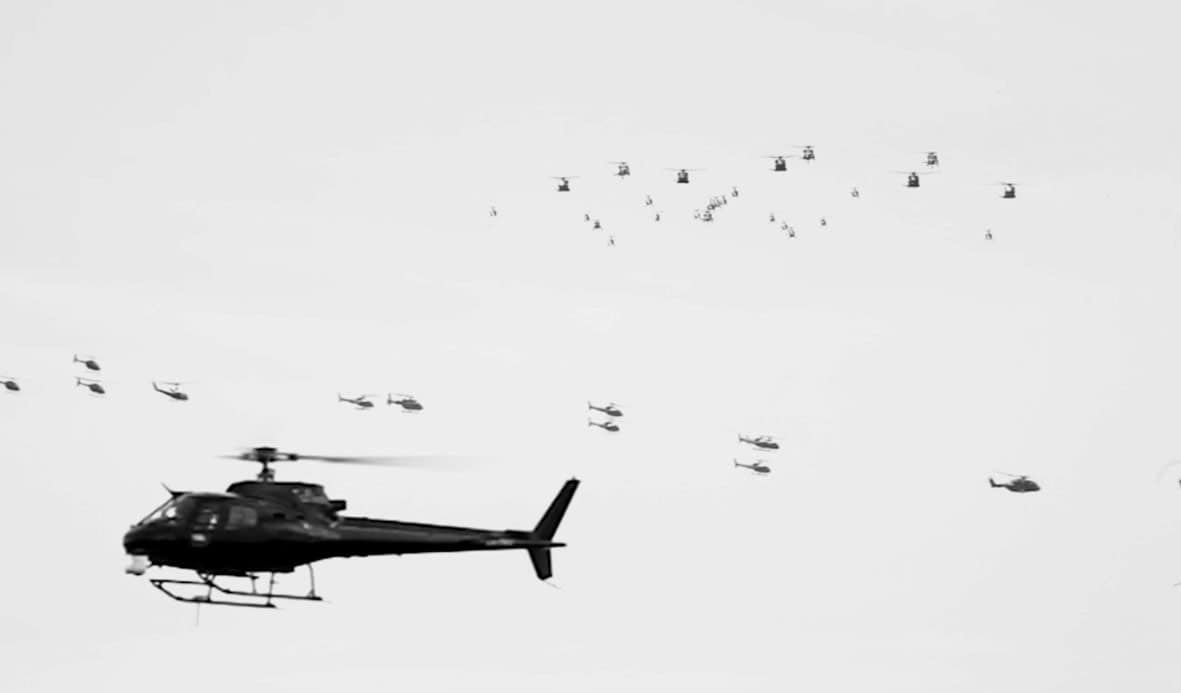
Shot during a series of international war game exercises in the Pacific and a response to the rhetoric of “The Pacific Century” being espoused by American politicians at the time, Swarm is a montage of the skyward component of these rehearsals. It is a moving image work with a sound accompaniment about aerial rehearsal and how very slowly the sky becomes crowded with the technology of conflict, until a crescendo is reached and we are once more left with silence. Swarm is an aerial ballet but where beauty is replaced by the harbinger of destruction.
Shadow Sites II
Jananne Al-Ani
2011, 8’38’’
Shadow Sites ll is a film that takes the form of an aerial journey. It is made up of images of a landscape that bears traces of natural and man made activity as well as ancient and contemporary structures. Seen from above the landscape appears abstracted, its buildings flattened and its inhabitants invisible to the human eye. Only when the sun is at its lowest do the features of the landscape, its archeological sites and settlements come to light. Such “shadow sites,” when seen from the air, map the latent images held by the landscape’s surface. Much like a camera’s photographic plate, the landscape holds the potential to be exposed thereby revealing the memory of its past. In the case of the Middle East, which provides the context for Al-Ani’s film, images of the landscape from William Holman Hunt’s Scapegoat of 1854 to the media images of the 1991 Desert Storm campaign have depicted the region as uninhabited, barren and without sign of civilization.
Trouble
Miranda Pennell
2023, 33’
Trouble is the second part of an archival project exploring histories of bombing. A filmmaker puzzles over aerial photographs from early 20th century Iraq and Egypt, and finds herself increasingly unsettled by images that want to share their violent secrets. England has been colonised by a marauding spirit as the Empire’s undead start to speak back to the film’s troubled investigator. Moving between past and present, this is a ghost story that explores horror, both real and imagined.
The Golden Cage
Hakan Topal
(part of The Golden Cage installation, Episodes I and III)
2022, 15’24’’
The Golden Cage video is part of a media installation based on the northern bald ibis (a.k.a “kelaynak” in Turkish), the most endangered migratory bird in the Middle East. When Palmyra fell to ISIS, the kelaynak colony, which migrates from Northeast Africa to Birecik (a small town near the Turkish-Syrian border), faced total extinction. In March 2016, the Birecik Kelaynak Reproduction Center decided not to release the birds from the confinement cages to protect them—the center has been keeping a semi-wild population since the late 1970s. The Golden Cage refers to a set of confinements amidst the never-ending catastrophes in the region; it is a poetic examination of artifacts, ruins, water bodies, and organisms spread across a highly nationalized terrain. As the embodied symbol of the state, the cage is enacted through a text translated into multiple languages to create new associations about borders, migrations, entrapments, and untranslatability.
This video was originally presented as part of an installation at Aga Khan Museum, Toronto; Mousonturm, Frankfurt and Depo, Istanbul.
The event will be held in Turkish, registration is not required.