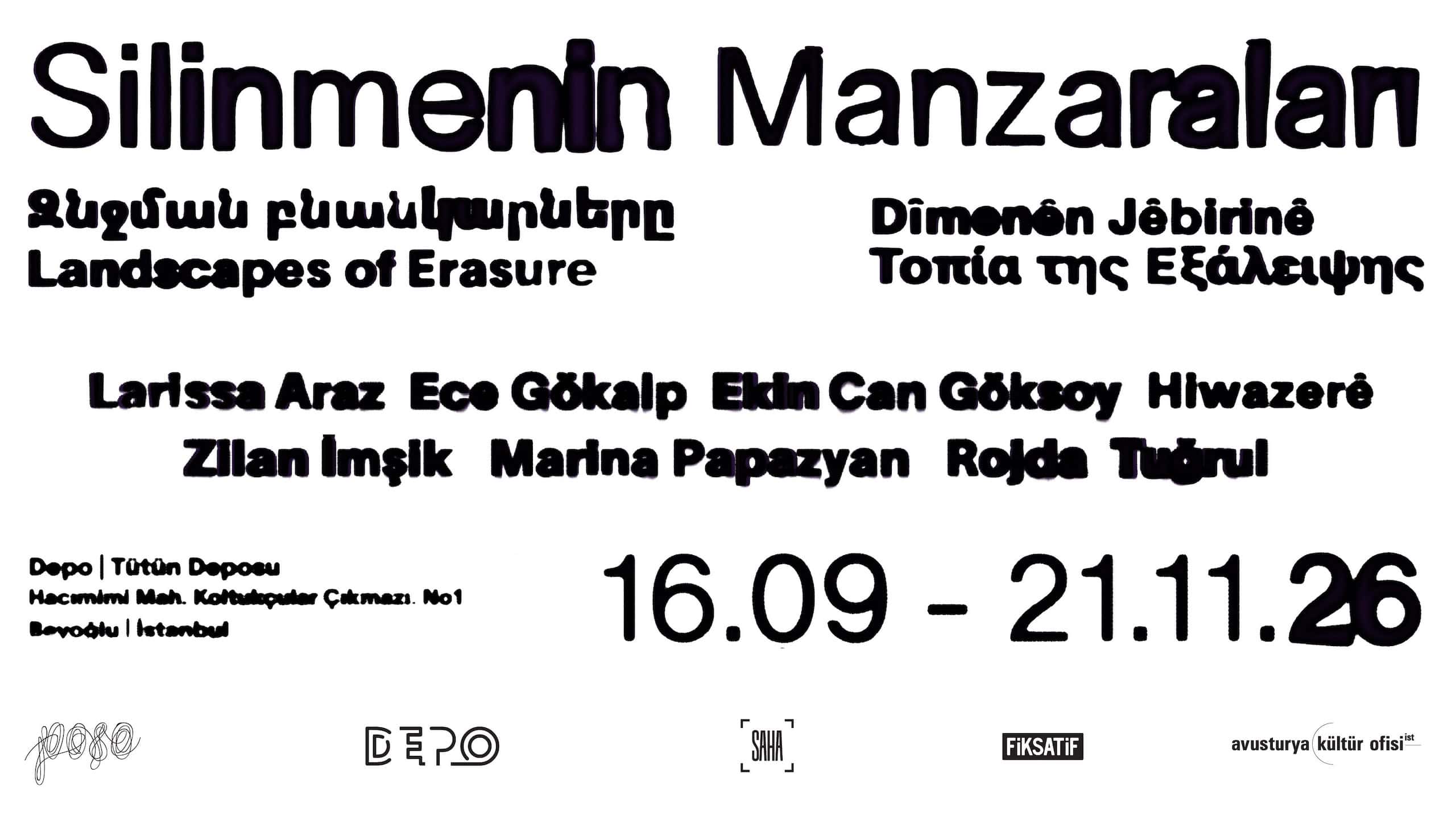
Landscapes of Erasure: Ekin Can Göksoy – Does Heat Make Us Forget?
October 3, 16:00 | October 23, 19:00, 2026
Does Heat Make Us Forget?
A Line of Reasoning on Global Warming and Collective Memory
Lecture/Performance: Ekin Can Göksoy
Performance team: Ece Gültekin, Emel Çetin, Emre Günsal, Yiğit Şahin
As part of the exhibition Landscapes of Erasure, on view at Depo until November 21, urban historian and writer Ekin Can Göksoy will present a lecture-performance exploring the relationship between the climate crisis and collective memory.
“Climate crisis, in one form or another, has held sway over the earth for ages. If today we feel it so acutely -if we take to the streets, press our politicians, and sink deeper each day into the sense that we are missing the boat- the reason is that this is the first crisis of our own making. Which is good news, in a way: what human hands have made, human hands can undo. But it is also bad news, because we have yet to witness a single one of the evils made by human hands actually being undone by them. And what if the reason for that is the climate crisis itself – what we call “global warming”?
Four hundred years ago, over the course of the long seventeenth century, the world lived through a great climate crisis. Working with climatologists and their data, historians came to call it the Little Ice Age. It was an age of winters in which the Golden Horn and the Bosphorus froze over and fairs were held on the ice of the Thames; of famines and waves of plague following hard upon one another; of the Celâlî rebellions in Anatolia and the Great Flight that emptied the villages; of the Thirty Years’ War; of an English Civil War that cost a king his head; of the Fronde in France and the revolts of Naples and Catalonia; of the fall of the Ming dynasty; and of witch hunts reaching their peak across nearly all of Europe. That all of this should resemble our own moment on the large scale is hardly surprising. What is surprising is the resemblance on the small scale — in what individual people lived through. Could an English country parson of the seventeenth century and the richest man of the twenty-first have approached authority in one and the same way? Could a peasant in the French countryside of the eighteenth century and a worker on strike today have papered over what they lived through in much the same manner? And if so, can we hold the climate crisis responsible for this state of perpetual forgetting we find ourselves in?”
Landscapes of Erasure examines the cultural, ecological, and social destruction caused by the late-Ottoman processes of modernization and centralization -which were systematically continued by the state during the Republican era- through works by artists carrying out research in various regions of Turkey. poşe’s final exhibition as an initiative, it marks the first time this group of artists -whose practices all engage collective memory and reckoning- has shared space, despite the increasingly repressive conditions of our present moment.
The event will be held in Turkish and registration is not required.
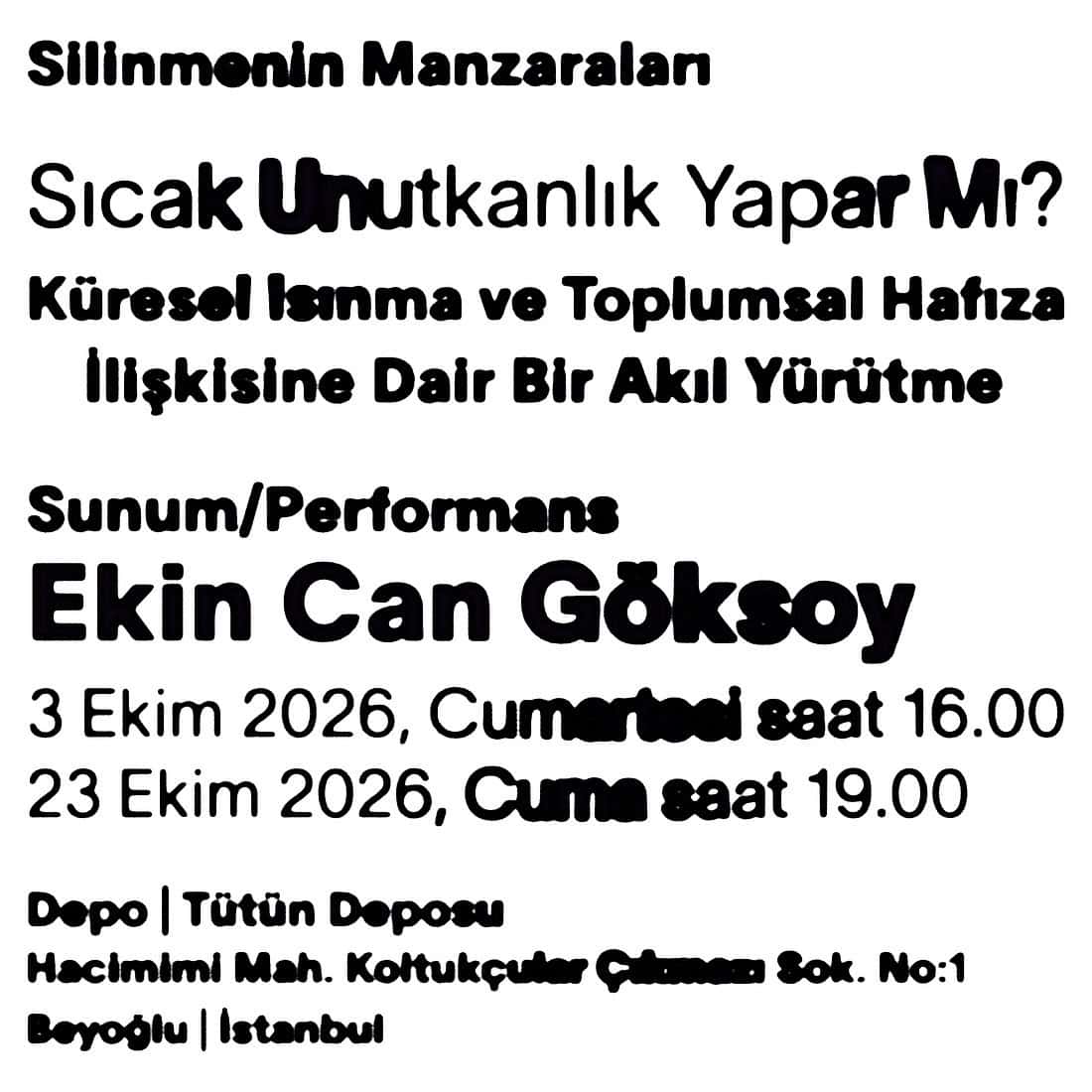
Landscapes of Erasure: Ekin Can Göksoy – Does Heat Make Us Forget?
Performance
October 3, 16:00 | October 23, 19:00, 2026
Does Heat Make Us Forget?
A Line of Reasoning on Global Warming and Collective Memory
Lecture/Performance: Ekin Can Göksoy
Performance team: Ece Gültekin, Emel Çetin, Emre Günsal, Yiğit Şahin
As part of the exhibition Landscapes of Erasure, on view at Depo until November 21, urban historian and writer Ekin Can Göksoy will present a lecture-performance exploring the relationship between the climate crisis and collective memory.
“Climate crisis, in one form or another, has held sway over the earth for ages. If today we feel it so acutely -if we take to the streets, press our politicians, and sink deeper each day into the sense that we are missing the boat- the reason is that this is the first crisis of our own making. Which is good news, in a way: what human hands have made, human hands can undo. But it is also bad news, because we have yet to witness a single one of the evils made by human hands actually being undone by them. And what if the reason for that is the climate crisis itself – what we call “global warming”?
Four hundred years ago, over the course of the long seventeenth century, the world lived through a great climate crisis. Working with climatologists and their data, historians came to call it the Little Ice Age. It was an age of winters in which the Golden Horn and the Bosphorus froze over and fairs were held on the ice of the Thames; of famines and waves of plague following hard upon one another; of the Celâlî rebellions in Anatolia and the Great Flight that emptied the villages; of the Thirty Years’ War; of an English Civil War that cost a king his head; of the Fronde in France and the revolts of Naples and Catalonia; of the fall of the Ming dynasty; and of witch hunts reaching their peak across nearly all of Europe. That all of this should resemble our own moment on the large scale is hardly surprising. What is surprising is the resemblance on the small scale — in what individual people lived through. Could an English country parson of the seventeenth century and the richest man of the twenty-first have approached authority in one and the same way? Could a peasant in the French countryside of the eighteenth century and a worker on strike today have papered over what they lived through in much the same manner? And if so, can we hold the climate crisis responsible for this state of perpetual forgetting we find ourselves in?”
Landscapes of Erasure examines the cultural, ecological, and social destruction caused by the late-Ottoman processes of modernization and centralization -which were systematically continued by the state during the Republican era- through works by artists carrying out research in various regions of Turkey. poşe’s final exhibition as an initiative, it marks the first time this group of artists -whose practices all engage collective memory and reckoning- has shared space, despite the increasingly repressive conditions of our present moment.
The event will be held in Turkish and registration is not required.
RELATED EXHIBITION
Landscapes of Erasure