

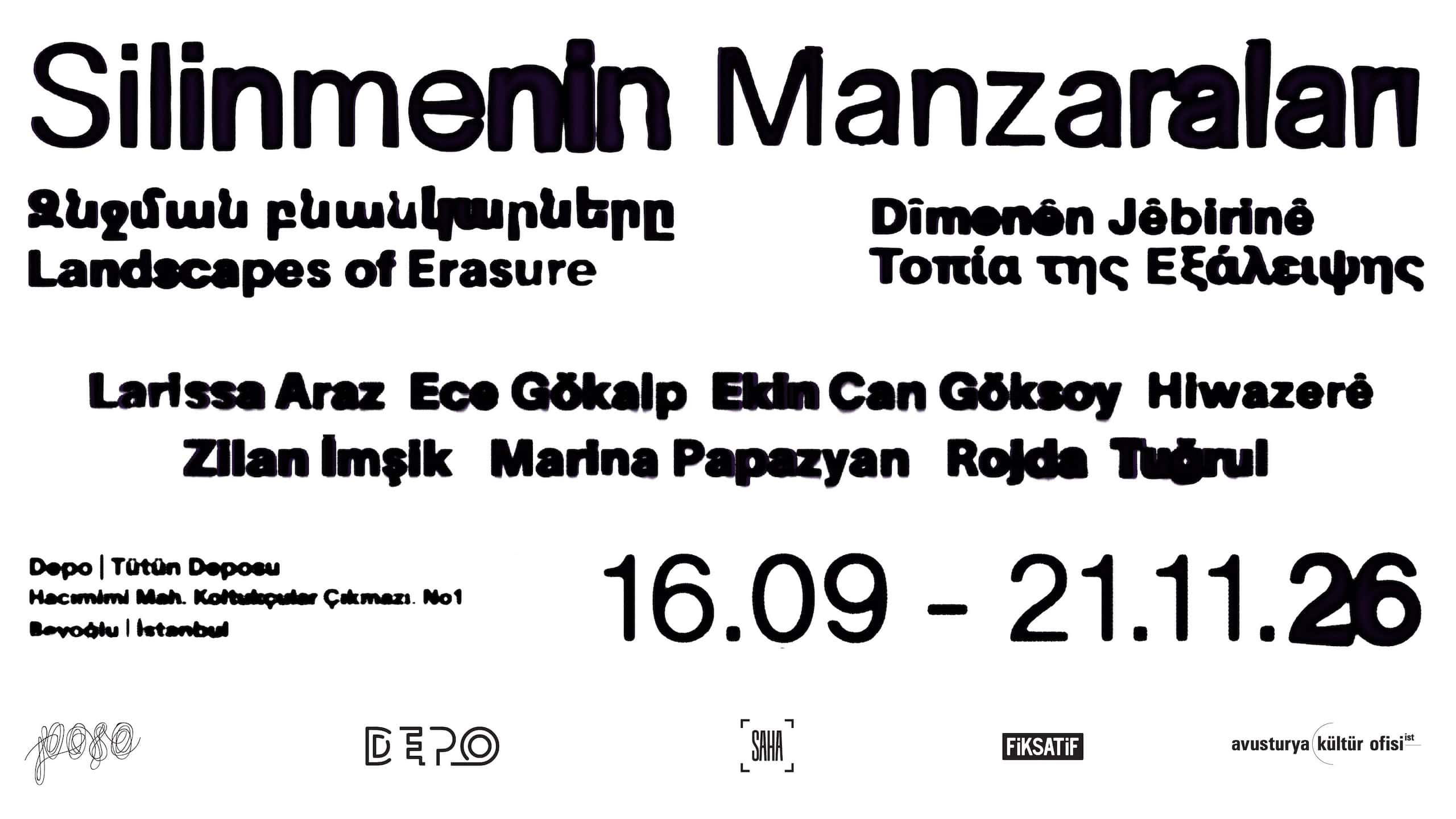
Landscapes of Erasure
September 16 – November 21, 2026
Opening: September 16, 18:30
Artists: Larissa Araz, Ece Gökalp, Ekin Can Göksoy, Hiwazerê, Zilan İmşik, Marina Papazyan, Rojda Tuğrul
Exhibition Coordinator: Sena Tural
Landscapes of Erasure examines the cultural, ecological, and social destruction caused by the late-Ottoman processes of modernization and centralization -which were systematically continued by the state during the Republican era- through works by artists carrying out research in various regions of Turkey. Some of the works trace the visible and invisible marks left upon the land, seeking access to a memory forced into concealment, while others investigate the mechanisms through which those traces were erased.
Ece Gökalp’s work After Anahit investigates the obliteration of land, history, and identity in collaboration with writer Hiwazerê through three distinct yet deeply connected subjects in northeastern Turkey: a 12,000-year-old glacial lake, a displaced ancient goddess, and a minoritized community. Larissa Araz’s photographic installation All that we see or seem are ghosts within a dream, presented behind the closed doors of the historical Nazaretyan Mansion, maps the building’s intricate relationship with Antep’s present-day economy, inviting the viewer to confront the aftermath of disaster.
Focusing on the forced disappearances that followed the 1980 coup, Zilan İmşik’s installation The Land of the Disappeared reconstructs the psychological landscape of the region through objects, instruments, and places that are tied to these events. Rojda Tuğrul’s video installation In the Zagros – A Hare follows the journey of a hare to explore the imaginary desire of a prey animal searching for its own predator. Tuğrul uses the narrative to unpack the complex ties between identity, displacement, and ecological ruin in conflict zones.
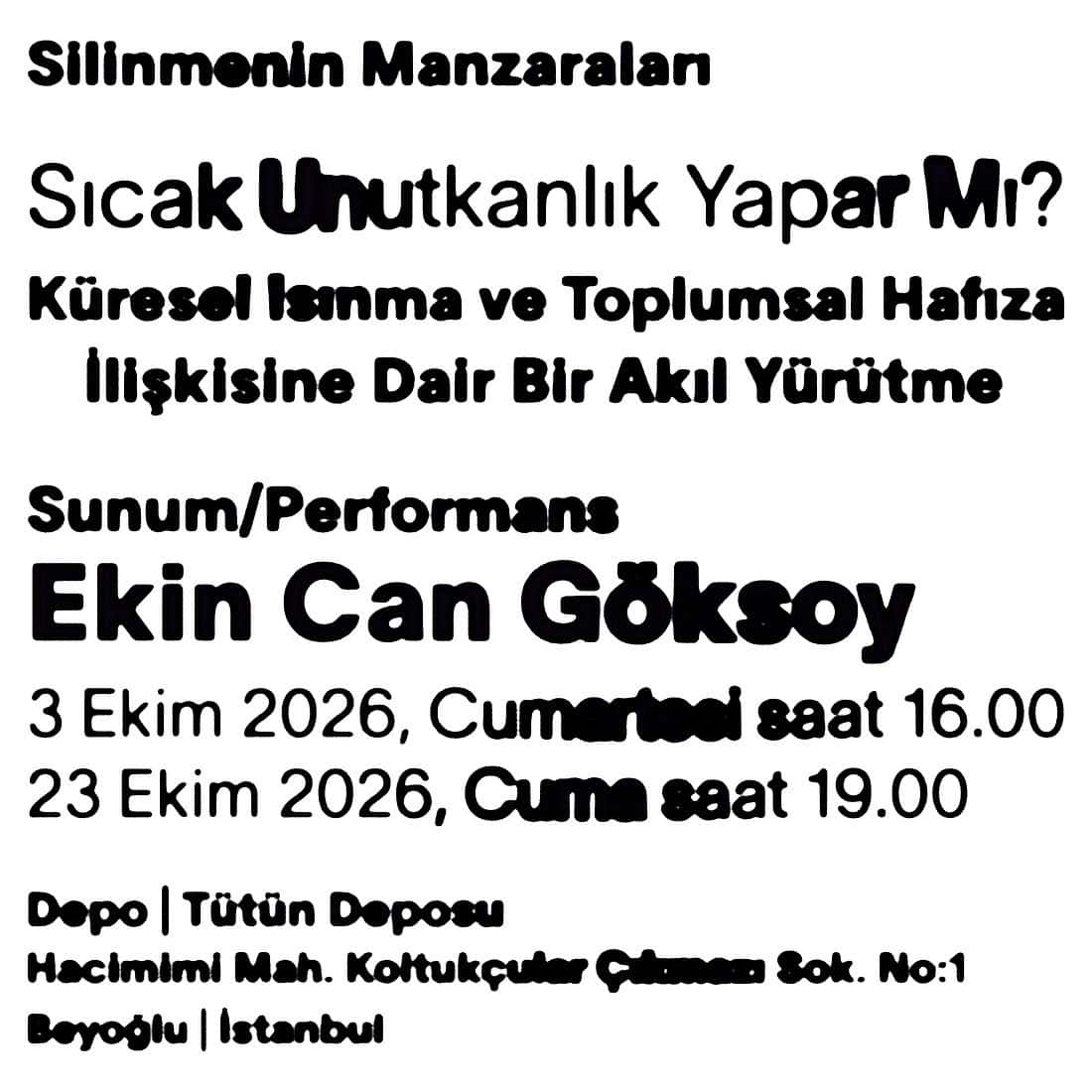
Marina Papazyan’s video work The Blood of the Mosquito reimagines Anopheles superpictus -one of the main malaria vectors in West Asia and the Mediterranean- as a monster hunting German officers in 1910s Cilicia. Papazyan treats the mosquito both as a symbol of imperialist exploitation and colonized peoples’ desire for vengeance. Ekin Can Göksoy stages Does Heat Make Us Forget?, an experimental performance framed as a reflection on the relationship between global warming and social memory.
Most of the artists participating in the exhibition live and work in the diaspora, and yet, the places they left behind persist in their artistic practices as a spectral presence and continue to shape their cultural memory. Conflicts inherited from previous generations and the practices of remembrance developed in response to histories of massacre and destruction form the discursive space of the exhibition.
Landscapes of Erasure, poşe’s final exhibition as an initiative, marks the first time this group of artists -whose practices all engage collective memory and reckoning- has shared space, despite the increasingly repressive conditions of our present moment.
The exhibition is supported by the SAHA Sustainability Fund.

23 September 2026
Depo’da “Silinmenin Manzaraları” sergisi
Deniz Burak BAYRAK – BirGün
Landscapes of Erasure
September 16 – November 21, 2026
Opening: September 16, 18:30
Artists: Larissa Araz, Ece Gökalp, Ekin Can Göksoy, Hiwazerê, Zilan İmşik, Marina Papazyan, Rojda Tuğrul
Exhibition Coordinator: Sena Tural
Landscapes of Erasure examines the cultural, ecological, and social destruction caused by the late-Ottoman processes of modernization and centralization -which were systematically continued by the state during the Republican era- through works by artists carrying out research in various regions of Turkey. Some of the works trace the visible and invisible marks left upon the land, seeking access to a memory forced into concealment, while others investigate the mechanisms through which those traces were erased.
Ece Gökalp’s work After Anahit investigates the obliteration of land, history, and identity in collaboration with writer Hiwazerê through three distinct yet deeply connected subjects in northeastern Turkey: a 12,000-year-old glacial lake, a displaced ancient goddess, and a minoritized community. Larissa Araz’s photographic installation All that we see or seem are ghosts within a dream, presented behind the closed doors of the historical Nazaretyan Mansion, maps the building’s intricate relationship with Antep’s present-day economy, inviting the viewer to confront the aftermath of disaster.
Focusing on the forced disappearances that followed the 1980 coup, Zilan İmşik’s installation The Land of the Disappeared reconstructs the psychological landscape of the region through objects, instruments, and places that are tied to these events. Rojda Tuğrul’s video installation In the Zagros – A Hare follows the journey of a hare to explore the imaginary desire of a prey animal searching for its own predator. Tuğrul uses the narrative to unpack the complex ties between identity, displacement, and ecological ruin in conflict zones.
Marina Papazyan’s video work The Blood of the Mosquito reimagines Anopheles superpictus -one of the main malaria vectors in West Asia and the Mediterranean- as a monster hunting German officers in 1910s Cilicia. Papazyan treats the mosquito both as a symbol of imperialist exploitation and colonized peoples’ desire for vengeance. Ekin Can Göksoy stages Does Heat Make Us Forget?, an experimental performance framed as a reflection on the relationship between global warming and social memory.
Most of the artists participating in the exhibition live and work in the diaspora, and yet, the places they left behind persist in their artistic practices as a spectral presence and continue to shape their cultural memory. Conflicts inherited from previous generations and the practices of remembrance developed in response to histories of massacre and destruction form the discursive space of the exhibition.
Landscapes of Erasure, poşe’s final exhibition as an initiative, marks the first time this group of artists -whose practices all engage collective memory and reckoning- has shared space, despite the increasingly repressive conditions of our present moment.
The exhibition is supported by the SAHA Sustainability Fund.
RELATED EVENTS
PRESS
23 September 2026
Depo’da “Silinmenin Manzaraları” sergisi
Deniz Burak BAYRAK – BirGün