
Dilan Cudi Saruhan
Perhaps The Sky
September 22 – November 21, 2026
Opening: September 22, 2026, 18:30
Power does not operate solely through the law; it establishes a spatial order -both through laws and beyond them- that extends to the shape of the land, the direction of the roads, the silence of the villages, the height of the walls, and the visibility of the sky. This order attempts to determine where people will stand, how they will move, what they will see, what they will forget, and even what they will be able to imagine. In Turkey, particularly in Kurdish geography, decades of policies of denial, securitization, and assimilation have produced such a spatial regime. Here, one does not simply learn the place in which one lives; the place one inhabits also settles within the person. The memory carried by the land becomes intertwined with the body’s way of walking. The bend of a road, the direction of the wind, or a landscape suddenly transformed by a flash of blue light… Each of these, over time, becomes part of the body’s memory. Violence settles into everyday life. It makes itself felt in a lowered voice while speaking, in a fingerprint that must be left every month, or in an ordinary object that suddenly becomes forbidden. Once it takes root within the natural rhythms of life, it becomes permanent. Perhaps this is why, in places where oppression is most intensely felt, art moves beyond representation and begins to produce new spaces. Dilan Cudi Saruhan’s practice is situated precisely at this threshold. Bringing together works from three different periods, the exhibition Perhaps The Sky makes visible how space shapes the human being, how and in what ways objects carry memory, how the line records time, and how imagination can establish new relations even under the most constrained conditions.
In the works she produced before going to prison, the artist examines the relationship between human beings and space through control, power, security, surveillance, and monitoring, working with small details embedded in everyday life rather than grand narratives. Here, at times, the way a light scans the darkness, a repeated walk, or an ordinary object becomes a silent witness to an invisible political order. In the works produced during her seven-year imprisonment, however, confinement ceases to be merely a physical condition; it becomes an experience and a form of resistance that pushes the boundaries of thought, creation, and imagination. During this period, the materials she uses become carriers of another temporality. Fabrics, handkerchiefs, undershirts, strands of hair, leaves, and unraveled threads bear silent records of lived experience. In the artist’s recent installations, the body becomes a permeable presence capable of transforming space. Hollow spaces that can be entered, compressed forms, and fragile structures evoke lives suspended between protection and refuge.
Closed doors, stairways, openings toward the sky, and fragile forms clinging to the wind do not place another world against reality; instead, they open small fissures within reality itself. The sky ceases to be a scenery and becomes the image of a shared horizon, an unfinished world, a “perhaps” that still needs to be reconstructed. And the handkerchief on which the artist has embroidered the words “Min ji bîr neke — Beni unutma” (“Do not forget me”) reminds us of the hundreds of political prisoners. Dilan Cudi Saruhan’s exhibition explores the possibility of a sky that does not yet exist.
Günseli Baki
Graphic Design: İlayda Tunca
Exhibition Text: Günseli Baki
English Translationî: Günseli Baki
Kurdish Translationdî: Siyabend Karakaş
Curatorial Team: Bahar Saruhan, Delal Eken, Rozelin Akgün, Y. Cemre Gürbüz
Teşekkürler: Asena Günal, Aslı Çetinkaya, Bakırköy Kadın Cezaevi’ndeki Sîyasî Tutsaklar / The Polîtîcal Prisoners at Bakırköy Women’s Prison / Girtîyên Sîyasî Yên li Girtîgeha Jinan a Bakırköyê, Barış Saruhan, Berivan Bekçi, Bülent Yıldırım-Doku Sanat Atölyesi, Çağla Leyla Kaya, Eda Önal, Eda Saruhan, Eda Yiğit, Ekin İnci, Emine Saruhan, Enver Saruhan, Emre Zeytinoğlu, Fırat Yusuf Yılmaz, Ferhat Can, Ferhat Özmen, Gabriel Oruç, Hale Eryılmaz, Hakim Peker, Haluk Ünal, Hatırlama Defteri Sanatçıları / Notebook of Recall Artists / Hunermendên Lenûska Bîranînê,Lal Laleş, Lamarts, M. Wenda Koyuncu, Mehmet Saruhan, Mert Sarısu, Necla Mizgin Argiş, Parma Beyoğlu, Rezan Gezer, Rojhat Demir, Seçkin Arslan, Selahattin Çolak, Sevim Sancaktar – Karşılaşmalar, Serkan Turgut, Sevgi Karay – Atölye20, Siyabend Karakaş, Taylan Öngünç, Turan Tayar, Yiğit Ekmekçi, Ozan Çağlar
29 September 2026
Henüz Bir Gökyüzü Yoktu
Günseli Baki – Sanat Okur
29 September 2026
Dilan Cudi Saruhan’ın 10 yıllık üretimi: Bir İhtimal Gökyüzü
yeni yaşam
25 September 2026
Metropolden – Beste Argat Balcı – Dilan Cudi Saruhan – Bir ihtimal gökyüzü
JIN TV
24 September 2026
Dilan Cudi Saruhan’ın “Bir İhtimal Gökyüzü” sergisi Tütün Deposu’nda
BirGün
23 September 2026
Dilan Cudi Saruhan’ın “Bir İhtimal Gökyüzü” sergisi Tütün Deposu’nda
Medyascope
23 September 2026
Dilan Cudi Saruhan’ın “Bir İhtimal Gökyüzü” sergisi Tütün Deposu’nda
T24
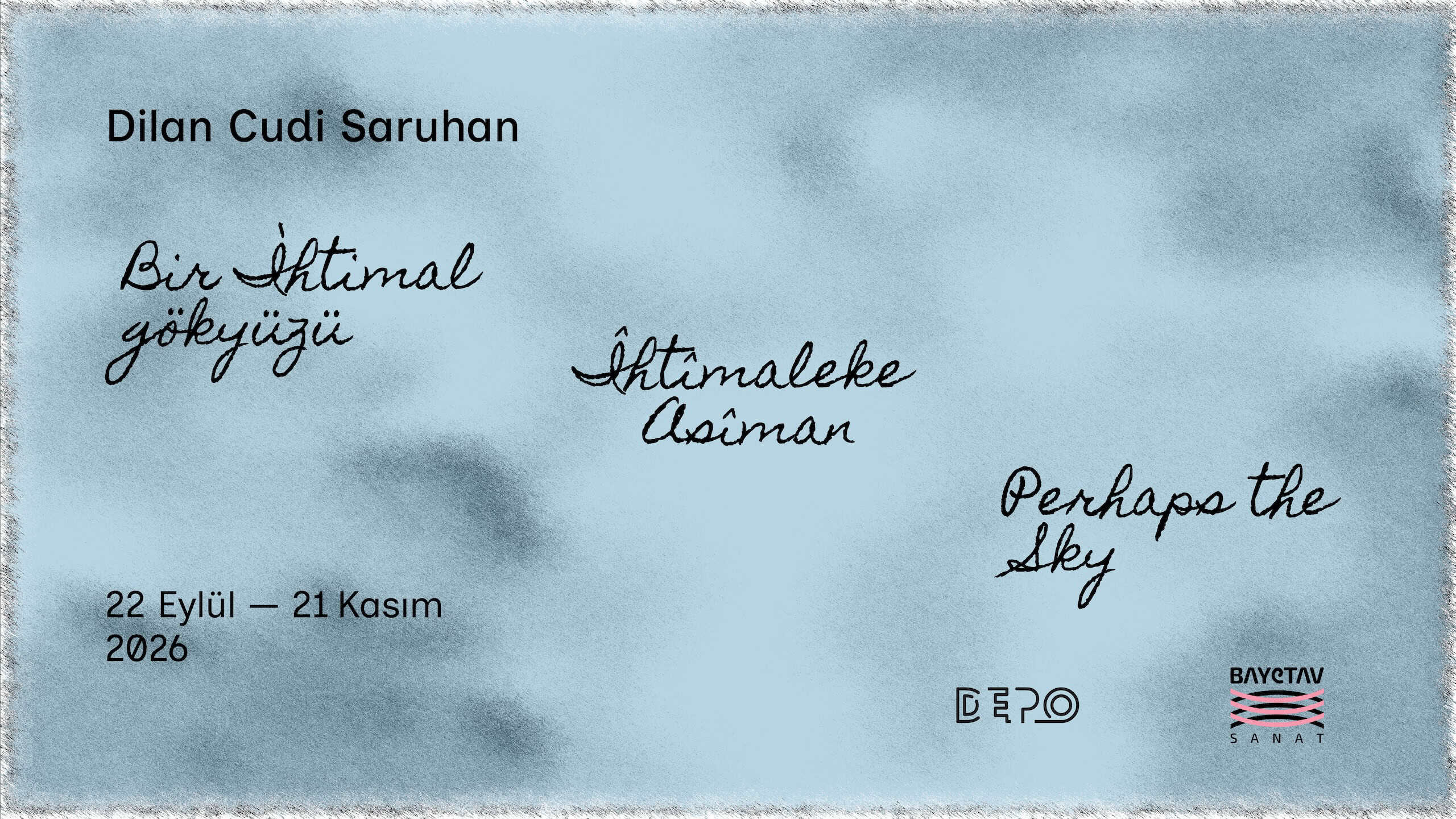
Dilan Cudi Saruhan
Perhaps The Sky
September 22 – November 21, 2026
Opening: September 22, 2026, 18:30
Power does not operate solely through the law; it establishes a spatial order -both through laws and beyond them- that extends to the shape of the land, the direction of the roads, the silence of the villages, the height of the walls, and the visibility of the sky. This order attempts to determine where people will stand, how they will move, what they will see, what they will forget, and even what they will be able to imagine. In Turkey, particularly in Kurdish geography, decades of policies of denial, securitization, and assimilation have produced such a spatial regime. Here, one does not simply learn the place in which one lives; the place one inhabits also settles within the person. The memory carried by the land becomes intertwined with the body’s way of walking. The bend of a road, the direction of the wind, or a landscape suddenly transformed by a flash of blue light… Each of these, over time, becomes part of the body’s memory. Violence settles into everyday life. It makes itself felt in a lowered voice while speaking, in a fingerprint that must be left every month, or in an ordinary object that suddenly becomes forbidden. Once it takes root within the natural rhythms of life, it becomes permanent. Perhaps this is why, in places where oppression is most intensely felt, art moves beyond representation and begins to produce new spaces. Dilan Cudi Saruhan’s practice is situated precisely at this threshold. Bringing together works from three different periods, the exhibition Perhaps The Sky makes visible how space shapes the human being, how and in what ways objects carry memory, how the line records time, and how imagination can establish new relations even under the most constrained conditions.
In the works she produced before going to prison, the artist examines the relationship between human beings and space through control, power, security, surveillance, and monitoring, working with small details embedded in everyday life rather than grand narratives. Here, at times, the way a light scans the darkness, a repeated walk, or an ordinary object becomes a silent witness to an invisible political order. In the works produced during her seven-year imprisonment, however, confinement ceases to be merely a physical condition; it becomes an experience and a form of resistance that pushes the boundaries of thought, creation, and imagination. During this period, the materials she uses become carriers of another temporality. Fabrics, handkerchiefs, undershirts, strands of hair, leaves, and unraveled threads bear silent records of lived experience. In the artist’s recent installations, the body becomes a permeable presence capable of transforming space. Hollow spaces that can be entered, compressed forms, and fragile structures evoke lives suspended between protection and refuge.
Closed doors, stairways, openings toward the sky, and fragile forms clinging to the wind do not place another world against reality; instead, they open small fissures within reality itself. The sky ceases to be a scenery and becomes the image of a shared horizon, an unfinished world, a “perhaps” that still needs to be reconstructed. And the handkerchief on which the artist has embroidered the words “Min ji bîr neke — Beni unutma” (“Do not forget me”) reminds us of the hundreds of political prisoners. Dilan Cudi Saruhan’s exhibition explores the possibility of a sky that does not yet exist.
Günseli Baki
Graphic Design: İlayda Tunca
Exhibition Text: Günseli Baki
English Translationî: Günseli Baki
Kurdish Translationdî: Siyabend Karakaş
Curatorial Team: Bahar Saruhan, Delal Eken, Rozelin Akgün, Y. Cemre Gürbüz
Teşekkürler: Asena Günal, Aslı Çetinkaya, Bakırköy Kadın Cezaevi’ndeki Sîyasî Tutsaklar / The Polîtîcal Prisoners at Bakırköy Women’s Prison / Girtîyên Sîyasî Yên li Girtîgeha Jinan a Bakırköyê, Barış Saruhan, Berivan Bekçi, Bülent Yıldırım-Doku Sanat Atölyesi, Çağla Leyla Kaya, Eda Önal, Eda Saruhan, Eda Yiğit, Ekin İnci, Emine Saruhan, Enver Saruhan, Emre Zeytinoğlu, Fırat Yusuf Yılmaz, Ferhat Can, Ferhat Özmen, Gabriel Oruç, Hale Eryılmaz, Hakim Peker, Haluk Ünal, Hatırlama Defteri Sanatçıları / Notebook of Recall Artists / Hunermendên Lenûska Bîranînê,Lal Laleş, Lamarts, M. Wenda Koyuncu, Mehmet Saruhan, Mert Sarısu, Necla Mizgin Argiş, Parma Beyoğlu, Rezan Gezer, Rojhat Demir, Seçkin Arslan, Selahattin Çolak, Sevim Sancaktar – Karşılaşmalar, Serkan Turgut, Sevgi Karay – Atölye20, Siyabend Karakaş, Taylan Öngünç, Turan Tayar, Yiğit Ekmekçi, Ozan Çağlar
RELATED EVENTS
PRESS
29 September 2026
Henüz Bir Gökyüzü Yoktu
Günseli Baki – Sanat Okur
29 September 2026
Dilan Cudi Saruhan’ın 10 yıllık üretimi: Bir İhtimal Gökyüzü
yeni yaşam
25 September 2026
Metropolden – Beste Argat Balcı – Dilan Cudi Saruhan – Bir ihtimal gökyüzü
JIN TV
24 September 2026
Dilan Cudi Saruhan’ın “Bir İhtimal Gökyüzü” sergisi Tütün Deposu’nda
BirGün
23 September 2026
Dilan Cudi Saruhan’ın “Bir İhtimal Gökyüzü” sergisi Tütün Deposu’nda
Medyascope
23 September 2026
Dilan Cudi Saruhan’ın “Bir İhtimal Gökyüzü” sergisi Tütün Deposu’nda
T24